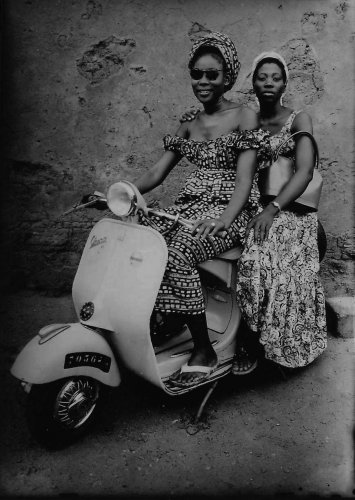
Seydou Keïta (1921-2001) is considered one of the greatest Malian photographers of the second half of the twentieth century. A self-taught photographer, he opened a studio in 1948 and specialized in portraiture. Seydou Keïta soon photographed all of Bamako and his portraits gained a reputation for excellence throughout West Africa.
His numerous clients were drawn by the quality of his photos and his great sense of aesthetics. Many were young men, dressed in European style clothing. Some customers brought in items they wanted to be photographed with but Keita also had a choice of European clothing and accessories - watches, pens, radios, scooter, etc. - which he put at their disposal in his studio. The women came in flowing robes often covering their legs and their throats, only beginning to wear Western outfits in the late 60s.
Seydou Keïta worked primarily with daylight and for economic reasons took only a single shot for each picture.
Seydou Keïta was discovered in the West in the 1990s. His first solo exhibition took place in 1994 in Paris at the Fondation Cartier. This was followed by many others in various museums, galleries and foundations worldwide
In August 1939, 10 days before the outbreak of World War II, a secret and extraordinary rescue
mission began in Paris, one that was conducted just like a military operation. Hundreds of workers and volunteers took part, all commanded by one man who was acting on his own initiative, without orders from his superiors.
This man, Jacques Jaujard, is the hero of the new French documentary “Illustrious Yet Unknown” (Illustre et Inconnu), directed by Jean-Pierre Devillers and Pierre Pochart. It will be screened on Friday morning (February 13) during the Epos International Art Film Festival at Tel Aviv Museum of Art.
Jaujard was deputy director of The Louvre museum, and foresaw the potential dangers for the art treasures there. On August 25, a few days before the Germans invaded Poland, Jaujard ordered the closure of the museum for three days, officially for repair work. On the first night, 800 of the most important works of art were removed from the walls, among them Leonardo da Vinci’s iconic "Mona Lisa." In the following days, some 4,000 works were packed up and loaded onto a fleet of vehicles, including hundreds of trucks, ambulances, private cars and taxis.
The stored works were marked according to their importance: in yellow, green and red. The "Mona Lisa," for example, was awarded three red circles. Not all the works could be packed in crates because of their dimensions: “The Raft of the Medusa” – an 1818 oil painting by French Romantic painter Théodore Géricault – had to be carried to a truck covered in a gigantic blanket.
When the order was given, a convoy of 203 vehicles set out, bearing 1,862 wooden crates with the priceless works of art. The destinations: castles throughout France, where the works would be kept safe until the troubles passed. The vehicles traveled at a speed of 40 kilometers per hour (25 mph). Electricity and telephone wires that would have impeded their passage were removed in advance, and the largest art rescue operation of World War II went without a hitch.
Mostly empty
The Nazis entered Paris in June 1940, and soon afterward Jaujard was asked to conduct a tour of the museum for Adolf Hitler’s emissary, Count Franz Wolff-Metternich, who was tasked with inspecting France’s art collection and overseeing the Kunstschutz (German appropriation of art).
As archival film in the documentary shows, few items remained in the museum by this point and it was mostly empty, albeit still open to visitors.
Jaujard wrote in his diary – extracts from which are quoted in the film – that Wolff-Metternich, who was not a member of the Nazi Party, felt relieved when he saw the empty museum. Jaujard sensed that, like other members of the German nobility, Wolff-Metternich did not feel much affection for the Nazi regime and intentionally “cheated” at his assignment, allowing Jaujard freedom of movement and protecting him from other elements in the regime. After the war, at Jaujard’s initiative, France awarded Wolff-Metternich the Légion d’honneur.
The Louvre was subordinated to the education minister of the Vichy government, which collaborated with the Nazis. Jaujard had to play a double diplomatic-political game – satisfying the regime, on the one hand, and protecting the art treasures on the other. In a circuitous way, he succeeded in doing this. However, his relations with the collaborative regime reached boiling point when Hermann Göring, Hitler’s deputy and an art collector in his own right, stole works of art that belonged to France. Jaujard wanted to submit a complaint to the authorities, but was advised to keep quiet lest something bad happen to him.read more:www.haaretz.com
As a young
girl learned the stiches, she was also initiated into her culture. Patterns,
colours and fabrics revealed her
village, tribe, social status, material wealth, and the period in which she
lived. Individuality was expressed in the way each woman assembled the piece of
her dress.
A young
girl’s skill in embroidery was noted by the older women and was equated with
her capabilities as a home maker. The finer her stitches, they said, the better
her groom. Until quite recently, nearly every Jordanian or Palestinian girl,
whatever her social class, embroidered her trousseau. The six to 12 loosely cut
robes she made were worn over a lifetime, and her bridal dress served for many
special occasions – and in some cases as her shroud.
Trousseau
on both sides of the Jordan River traditionally included embroidered cushions
that were as beautiful and varied as the dress. Today, it is the cushions that
have carried this art into modern-day life in Jordan: in many homes, the décor is
not complete without one or more matching sets. Their colours can range from
red, maroon, purple and pink, spiked with orange, green, and gold, to a more
sober combination that instead emphasises the artistry of the needlework. The simple
cross-stitch forms the basis for the myriad designs, and the recurring motifs
tend to be drawn from nature.
Contemporary
pieces include large wall- hangings stitched with the “tree of life” motif and
elegant quilts based on the popular “horse’s hoof” design.
Sunday 17th marked the first day of the Amazigh New Year 2966 and I had the privilege to assist and celebrate along with the Moroccan community of Padua (Italy) this awesome event that I didn't know before. It has no religious connotation and it is linked to the first inhabitants of Morocco, which had a very rich cultural and artistic heritage which they are proud of.
Who are the Amazighs?
The Berbers or Amazighs are an ethnic group indigenous lived in north Africa long before the arrival of the Arabs, and their culture probably dates back more than 4,000 years. The Amazigh which means "free humans" or "free men" are known to the world as Berbers . In fact, the word Berbers is offensive to these ancient inhabitants of north Africa and the Sahara desert. The name "Berber" is another one of many peccadilloes of the Romans who threw names at people left and right. They, along with the Greeks referred to every people they could not understand with the same unintelligible Berber language whether they were in the East or the West.
Amazigh art and culture
Traditionally, men take care of livestock. They migrate by following the natural cycle of grazing, and seeking water and shelter. They are thus assured with an abundance of wool, cotton and plants used for dyeing. For their part, women look after the family and handicrafts - first for their personal use, and secondly for sale in the souqs in their locality. The Amazigh tribes traditionally weave kilims. The tapestry maintains the traditional appearance and distinctiveness of the region of origin of each tribe, which has in effect its own repertoire of drawings. The textile of plain weave is represented by a wide variety of stripes, and more rarely by geometrical patterns such as triangles and diamonds. Additional decorations such as sequins or fringes, are typical of Amazigh weave in Morocco. The nomadic and semi-nomadic lifestyle of the Amazigh is very suitable for weaving kilims. The customs and traditions differ from one region to another. The social structure of the Amazigh is tribal. A leader is appointed to command the tribe. In the Middle Ages, many women had the power to govern, such as Kahina and Tazoughert Fatma in Aurès, Tin Hinan in Hoggar, Chemci in Aït Iraten, Fatma Tazoughert in the Aurès. Lalla Fatma N'Soumer was a Amazigh woman in Kabylie who fought against the French. The majority of Amazigh tribes currently have men as heads of the tribe.
A Berberist flag
Amazigh Folklore and festivals
Ahwash dance is part of Moroccan Amazigh culture and folklore. Ahouch, known as the dance of the village, is a popular music and dance from the High Atlas and the Anti-Atlas Mountains performed by the Berbers. The lyrics are always in Amazigh language, in the Tashelhit dialect, which spoken in southwestern Morocco. Ahouch exists in its purest form in the region of Ibrkak located in Tata. The word "Ahouach" means group dances in Tamazight, dances related to one another, poetic improvisation, individual and group singing in Tashelhit through rhythms alternating from slow to fast. The Ahouach dance and music bring together villagers, tribes ”Taghbilt” in Tamazight (usually a group of small villages), families at all important moments of life. Ahouch is part of a celebration and social life of Amazighen,and is danced by men and women dancing and singing in harmony - sometimes only by women, sometimes exclusively by men, but always in groups. It begins with an improvisation sung solo, in a shrill voice. Then the men or women in chorus sing songs about love, celebrating nature or events with the rest of tribe drumming, clapping, stomping to the rythem of the movements .
Jean Mohr (born 13 September 1925 in Geneva, Switzerland) is a Swiss documentary photographer who has been active since 1949, primarily with some of the major humanitarian organizations of the world, including the United Nations High Commission for Refugees, the International Committee of the Red Cross (ICRC), United Nations Relief and Works Agency for Palestine Refugees in the Near East (UNRWA), the World Health Organization, and the International Labour Organization.
For the last 50 years photographer Jean Mohr has been documenting day-to-day life in Israel and the Palestinian territories for the ICRC. Palestine, its refugee camps, precarious sanitary conditions, and the Gaza stalemate, whilst being the subject of major media attention, is a case worthy of reconsideration. It needs to be regularly re-explained and repositioned in the context of the Israeli-Arab conflict.
Globalization in our modern society, which is arguably increasingly more complex, has brought about a 'Clash of Civilizations' due to a lack of desire to understand and truly accept each other's humanity.
Different cultures, traditions, dreams and aspirations results in inevitable simplistic reductions in the form of stereotypes. Alternatively, conformity to each other breeds an arrogant confidence that excludes those who do not adapt, accentuating in this way more and more the gaps and the immeasurable differences that exist in modern societies.
This mutual misunderstanding, especially concerning the complex issue between Occident and Orient, comes the work of the photographer Fatima Abbadi and in particular her research and work of "Orientalism Parallel". Her photographic production is personal, meaningful, balanced and objective. The photographs capture moments of daily life and makes us discover that life on the streets, those children, those men, those women, those old people of the Orient are otherwise so similar with the humanity of the Occident.
And so, through the unique method of photography, the disagreements and differences that divide us, even if only momentary, are captured in universal harmony and bringing forth a new insight on our shared humanity.
Femininity isadelicateandimpalpablelanguage. It's not an exposed female bodyor an incarnatebeauty butrather a unique form of collected emotionsandfeelings. Unfortunately, inmodern timespeople oftenassociatefemininitywith classic clichés,imposedanddictatedby society, exchangingfemininitywiththecrude and nude body language; thus givinga distorted image of the female construct.
With this exhibition "Portraits"the photographerdoes not intend toexhibit thefemale bodybut rather invites the viewer to engage in a dialogue with the portrayed person with the intent of discovering thelost femininityof our times.
 His numerous clients were drawn by the quality of his photos and his great sense of aesthetics. Many were young men, dressed in European style clothing. Some customers brought in items they wanted to be photographed with but Keita also had a choice of European clothing and accessories - watches, pens, radios, scooter, etc. - which he put at their disposal in his studio. The women came in flowing robes often covering their legs and their throats, only beginning to wear Western outfits in the late 60s.