lunedì 25 gennaio 2016

Padua celebrates the Amazigh New Year

Sunday 17th marked the first day of the Amazigh New Year 2966 and I had the privilege to assist and celebrate along with the Moroccan community of Padua (Italy) this awesome event that I didn't know before. It has no religious connotation and it is linked to the first inhabitants of Morocco, which had a very rich cultural and artistic heritage which they are proud of. 


Who are the Amazighs?
The Berbers or Amazighs are an ethnic group indigenous lived in north Africa long before the arrival of the Arabs, and their culture probably dates back more than 4,000 years. The Amazigh which means "free humans" or "free men" are known to the world as Berbers . In fact, the word Berbers is offensive to these ancient inhabitants of north Africa and the Sahara desert. The name "Berber" is another one of many peccadilloes of the Romans who threw names at people left and right. They, along with the Greeks referred to every people they could not understand with the same unintelligible Berber language whether they were in the East or the West.


Amazigh art and culture

Traditionally, men take care of livestock. They migrate by following the natural cycle of grazing, and seeking water and shelter. They are thus assured with an abundance of wool, cotton and plants used for dyeing. For their  part, women look after the family and handicrafts - first for their personal use, and secondly for sale in the souqs in their locality. The Amazigh tribes traditionally weave kilims. The tapestry maintains the traditional appearance and distinctiveness of the region of origin of each tribe, which has in effect its own repertoire of drawings. The textile of plain weave is represented by a wide variety of stripes, and more rarely by geometrical patterns such as triangles and diamonds. Additional decorations such as sequins or fringes, are typical of Amazigh weave in Morocco. The nomadic and semi-nomadic lifestyle of the Amazigh is very suitable for weaving kilims. The customs and traditions differ from one region to another. The social structure of the Amazigh is tribal. A leader is appointed to command the tribe. In the Middle Ages, many women had the power to govern, such as Kahina and Tazoughert Fatma in Aurès, Tin Hinan in Hoggar, Chemci in Aït Iraten, Fatma Tazoughert in the Aurès. Lalla Fatma N'Soumer was a Amazigh woman in Kabylie who fought against the French. The majority of Amazigh tribes currently have men as heads of the tribe. 
A Berberist flag
Amazigh Folklore and festivals

Ahwash dance is part of Moroccan Amazigh culture and folklore. Ahouch, known as the dance of the village, is a popular music and dance from the High Atlas and the Anti-Atlas Mountains performed by the Berbers. The lyrics are always in Amazigh language, in the Tashelhit dialect, which spoken in southwestern Morocco. Ahouch exists in its purest form in the region of Ibrkak located in Tata. The word "Ahouach" means group dances in Tamazight, dances related to one another, poetic improvisation, individual and group singing in Tashelhit through rhythms alternating from slow to fast. The Ahouach dance and music bring together villagers, tribes ”Taghbilt” in Tamazight (usually a group of small villages), families at all important moments of life. Ahouch is part of a celebration and social life of Amazighen,and is danced by men and women dancing and singing in harmony - sometimes only by women, sometimes exclusively by men, but always in groups. It begins with an improvisation sung solo, in a shrill voice. Then the men or women in chorus sing songs about love, celebrating nature or events with the rest of tribe drumming, clapping, stomping to the rythem of the movements .


More Reading:

mercoledì 23 dicembre 2015

Side by Side or Face to Face: 50 years of photography by Jean Mohr

Jean Mohr (born 13 September 1925 in Geneva, Switzerland) is a Swiss documentary photographer who has been active since 1949, primarily with some of the major humanitarian organizations of the world, including the United Nations High Commission for Refugees, the International Committee of the Red Cross (ICRC), United Nations Relief and Works Agency for Palestine Refugees in the Near East (UNRWA), the World Health Organization, and the International Labour Organization.

For the last 50 years photographer Jean Mohr has been documenting day-to-day life in Israel and the Palestinian territories for the ICRC. Palestine, its refugee camps, precarious sanitary conditions, and the Gaza stalemate, whilst being the subject of major media attention, is a case worthy of reconsideration. It needs to be regularly re-explained and repositioned in the context of the Israeli-Arab conflict. 


London exhibition: ‘Parallel Orientalism’


Globalization in our modern society, which is arguably increasingly more complex, has brought about a 'Clash of Civilizations' due to a lack of desire to understand and truly accept each other's humanity. 

Different cultures, traditions, dreams and aspirations results in inevitable simplistic reductions in the form of stereotypes. Alternatively, conformity to each other breeds an arrogant confidence that excludes those who do not adapt, accentuating in this way more and more the gaps and the immeasurable differences that exist in modern societies. 


This mutual misunderstanding, especially concerning the complex issue between Occident and Orient, comes the work of the photographer Fatima Abbadi and in particular her research and work of "Orientalism Parallel". Her photographic production is personal, meaningful, balanced and objective. The photographs capture moments of daily life and makes us discover that life on the streets, those children, those men, those women, those old people of the Orient are otherwise so similar with the humanity of the Occident.

And so, through the unique method of photography, the disagreements and differences that divide us, even if only momentary, are captured in universal harmony and bringing forth a new insight on our shared humanity.


http://www.arabbritishcentre.org.uk/event/exhibition-parallel-orientalism-fatima-abbadi/

mercoledì 14 ottobre 2015

Portraits

Femininity is a delicate and impalpable language. It's not an exposed female body or an incarnate beauty but rather a unique form of collected emotions and feelings. Unfortunately, in modern times people often associate femininity with classic clichés, imposed and dictated by society, exchanging femininity with the crude and nude body language; thus giving a distorted image of the female construct.  

With this exhibition "Portraits" the photographer does not intend to exhibit the female body but rather invites the viewer to engage in a dialogue with the portrayed person with the intent of discovering the lost femininity of our times.

martedì 7 aprile 2015

Into the Promised Land: Photo-essay Portraying Palestinian Life in the West Bank and Gaza Strip by John Tordai (Photographer)

A portrait of the people of Palestine showing not only the turmoil of the Arab-Israeli conflict but also scenes from a daily life which has been characterised by over twenty years of military occupation.

For almost twenty five years the Palestinians of the West Bank and Gaza Strip have endured military occupation and, at the same time, have watched the creeping annexation of their patrimony, much of it given over to settlements. Such pressure led inexorably to the intifada and these photographs, taken between 1988 – 90, roughly span the period wich began with a popular uprising and ended in attrition. They reflect broadly what could be found on the streets any day of the week, evoking both the unchanging rhythms of daily life as well as the pathos and desolation wich, inevitably, have grown out of this enduring conflict. If a lasting peace were achieved, the photographs might be seen only as a painful episode in the rites of passage, but given the depth of the conflict they might as easily be viewed as the preface to a descent into perdition.

 Text by J.C.Tordai %%%%%%%%%%%%%%%%%%%%%%%%%%%%%%%%%%%%%%%%%
Title: INTO THE PROMISED LAND 
Authors: text by Harvey Morris, Photographs by J.C.Tordai 
Publisher: CORNERHOUSE Publications Year: 1991 
Number of pages: 80 %%%%%%%%%%%%%%%%%%%%%%%%%%%%%%%%%%%%%%%%%


John Tordai has been photographing Palestinians for twenty years. He was in Gaza in the early 1980s, before it became the haunt of journalists and TV crews. He returned during the exhilarating early months of the first Palestinian intifada – when all seemed possible – and stuck around as the uprising sank into a mire of Israeli siege, Palestinian violence, and political stalemate. He was in place to watch the entrée of the “peace process,” as embodied by the return of Yasser Arafat and the remnants of the Palestine Liberation Organization to Gaza in 1994 and the slow, deformed birth of the Palestinian Authority. And he was there again in September 2000 when that artifice finally collapsed amid the blood, arms, and death of the Intifadat al Aqsa, the second Palestinian national revolt in less than a decade.

mercoledì 25 febbraio 2015

First woman photographer in Palestine: Karima Abboud


Before the British Mandate, passports of Palestinian women did not include personal identication photos. In order to confirm the identity of a woman passport holder, officers used to simply call out her name and that of her husband’s, or her father’s if she was single. As photography was discovered and became an enormously signi!cant manifestation of modernity, it spread across the Arab cities in the late first quarter of the twentieth century. The first school of photography in the Arab world was established in Jerusalem, founded by Bishop Yasai Gradian in the late nineteenth century, and had the most important photographers of Palestine as its students. However, Palestinian photography was almost entirely monopolized by men until Karima Aboud broke the norm. Karima Aboud was born in Bethlehem in 1894, in the family of Lebanese descent originally from southern town of Al-Khiam, later displaced to Nazareth. Karima was first taught the craft of photography by an Armenian photographer in Jerusalem, and started to practice in 1913. Her father gave her the !rst camera, and she began to take photos of natural sceneries, cities, historical monuments, of family members and friends. Later, Karima opened her first studio as a professional photographer. She photographed women of Bethlehem, which encouraged conservative families to photograph their women without embarrassment. She was soon able to open a photo coloring studio. There are more than 400 photographs taken by Karima Aboud existing today in a private collection of an Israeli collector. Many other works by her gradually spread across affluent families, and recently a second collection dating back to1913 was discovered. Karima Aboud may not be the first woman to ever hold a photographic camera, but she certainly was the First Palestinian woman photographer. 


mercoledì 18 febbraio 2015

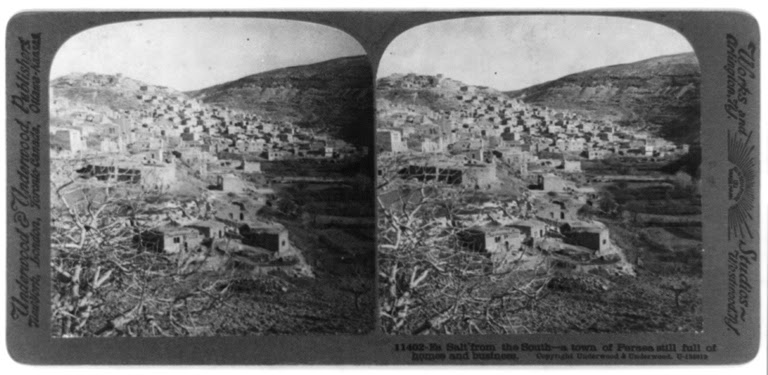
السلط ‎ Al-Salt

Salt (Arabic: السلط‎ Al-Salt — pronounced Es-Sult or Es-Salt) is an ancient agricultural town and administrative centre in west-central Jordan. It is on the old main highway leading from Amman to Jerusalem. Situated in the Balqa highland, about 790–1,100 metres above sea level, the town is built in the crook of three hills, close to the Jordan Valley. One of the three hills, (Jebal Al Qal'a), is the site of a 13th-century ruined fortress.

Complete reading about Salt city


Es Salt back in history of photography

Collections:
Matson (G. Eric and Edith) Photograph Collection


Title: General view of Es-Salt
Creator(s): Matson Photo Service, photographer
Date Created/Published: between 1950 and 1977


Title: General view of Es-Salt
Creator(s): American Colony (Jerusalem). Photo Dept., photographer
Date Created/Published: [between 1898 and 1914]

Title: A home in Es-Salt. Showing interior of a peasant home.
Creator(s): American Colony (Jerusalem). Photo Dept., photographer
Date Created/Published: [approximately 1920 to 1933]


 Title: Bedouin of Es-Salt, sitting in doorway, sewing.
Creator(s): American Colony (Jerusalem). Photo Dept., photographer
Date Created/Published: [approximately 1920 to 1933]
Creator(s): American Colony (Jerusalem), Photo Dept.,
Date Created/Published: [approximately 1920 to 1933]
Title: Bedouin life in Trans-Jordan. Semi Bedouin types of Es Salt. Young man and mother at hot springs of Zerka Ma'in


Title: Street in Es-Salt (Salt in Transjordan)
Creator(s): Matson Photo Service, photographer
Date Created/Published: [between 1940 and 1946]


Title: The High Commissioner's first visit to Transjordan. Sir Herbert Samuel passing through street of Es-Salt
Creator(s): American Colony (Jerusalem) Photo Dept., photographer
Date Created/Published: [between 1920 and 1925]

Creator(s): 
Underwood & Underwood, publisher


Stereograph Card
Date Created/Published: c1913 Sept. 29.


All pictures belong to library of congress