Yousuf Karsh (1908 – 2002) was an Armenian–Canadian portrait photographer. He has been called one of the great portrait photographers of the 20th century by Time magazine and the Metropolitan Museum of Art, with the latter noting the "distinct style in his theatrical lighting."
Yousuf Karsh was born in Mardin, a city in the eastern Ottoman Empire (present Turkey). He grew up during the Armenian Genocide where he wrote, "I saw relatives massacred; my sister died of starvation as we were driven from village to village." At the age of 16, his parents sent Yousuf to live with his uncle George Nakash, a photographer in Sherbrooke, Quebec, Canada. Karsh briefly attended school there and assisted in his uncle’s studio. Nakash saw great potential in his nephew and in 1928 arranged for Karsh to apprentice with portrait photographer John Garo in Boston, Massachusetts, United States. His brother, Malak Karsh, was also a photographer.
Karsh returned to Canada four years later, eager to make his mark. In 1931 he started working with photographer John Powls, in his studio on the second floor of the Hardy Arcade at 130 Sparks Street in Ottawa, Ontario, close to Parliament Hill. When Powls retired in 1933, Karsh took over the studio. Karsh's first solo exhibition was in 1936 in the Drawing Room of the Château Laurier hotel. He moved his studio into the hotel in 1973, and it remained there until he retired in 1992.
Canadian Prime Minister Mackenzie King discovered Karsh and arranged introductions with visiting dignitaries for portrait sittings. Karsh's work attracted the attention of varied celebrities and on 30 December 1941 he photographed Winston Churchill, after Churchill gave a speech to Canadian House of Commons in Ottawa....
"I needed to live among the people, hear them talk about themselves in Artas, make records while they spoke of their life, customs and ways of looking at things. For that reason I decided to remain in Palestine---" Hilma Granqvist 1931, introduction to Marriage Conditions in a Palestinian Village
Hilma Granqvist (nicknamed 'Sitt Halima' in Palestine) was a Swedish-speaking Finnish anthropologist who conducted long field studies of Palestinians. In the 1920s Granqvist arrived at the village of Artas, just outside Bethlehem in the then British Mandate of Palestine as part of her research on the women of the Old Testament. She had gone to Palestine "in order to find the Jewish ancestors of Scripture. What she found instead was a Palestinian people with a distinct culture and way of life. She therefore changed the focus of her research to a full investigation of the customs,
habits and ways of thinking of the people of that village. Granqvist ended up staying until 1931 documenting all aspects of village life. In so doing she took hundreds of photographs."
Hilma Granqvist's international reputation is based on five extensive ethnographic works that focus on a Palestinian village in the 1920's. Granqvist was also an innovative photographer. During her research she took about 1000 photographs that greatly contribute to visual anthropology. Granqvist broke the prevailing research tradition of perceiving of foreign peoples as mere proof of the versatility of the human race and the subjects of research as anonymous objects. Granqvist documented people in their activities - in their every chores or going through the rituals related to different phases of life.
The research which Hilma Granqvist undertook between 1925 and 1931 provided her with most of the material, that later became the content of her published work. In 1931 she published Marriage conditions in a Palestinian village vol. 1 and in 1935 the second volume appeared. These two volumes offer a detailed description of marriage stages and some aspects of family life.
Based on the materials collected during the years from 1925 to 1931, the two volumes dedicated to childhood, Birth and childhood among the Arabs (1947) and Child Problems among the Arabs
(1950), offer a complete overview of children's way of life of the Palestinian village Artas, starting from the phase of pregnancy. In the first book the author describes the customs and traditions regarding conception, pregnancy, birth and post-natal practices, such as social and religious education, training and circumcision. The second book deals with the health and care of the child, examining issues such as infant mortality and devoting a large part of the description to rituals that ward off evil forces. It also provides a detailed list of names that were actually chosen for children, with several tables divided by gender and derivation. The two books can be considered a continuation of the previous publications of the author,
Marriage conditions in a Palestinian villagevolumes I (1931) and II (1935), which concern the same
group of people and give a complete picture of the family in the community of Artas.
In 1965 she published the results of her last period of research: Muslim death and burial. Arab customs and traditions studied in a village in Jordan. Here she describes customs and beliefs about illness and death.
Publications: Marriage Conditions in a Palestinian Village I. 1932 Marriage Conditions in a Palestinian Village II. 1935 Birth and Childhood in an Arab Village. 1947 Child Problems Among the Arabs. 1950 Muslim Death and Burial. 1965
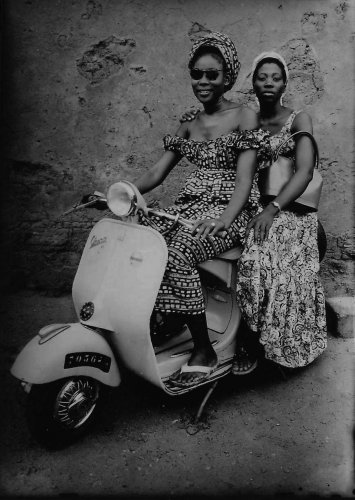
Seydou Keïta (1921-2001) is considered one of the greatest Malian photographers of the second half of the twentieth century. A self-taught photographer, he opened a studio in 1948 and specialized in portraiture. Seydou Keïta soon photographed all of Bamako and his portraits gained a reputation for excellence throughout West Africa.
His numerous clients were drawn by the quality of his photos and his great sense of aesthetics. Many were young men, dressed in European style clothing. Some customers brought in items they wanted to be photographed with but Keita also had a choice of European clothing and accessories - watches, pens, radios, scooter, etc. - which he put at their disposal in his studio. The women came in flowing robes often covering their legs and their throats, only beginning to wear Western outfits in the late 60s.
Seydou Keïta worked primarily with daylight and for economic reasons took only a single shot for each picture.
Seydou Keïta was discovered in the West in the 1990s. His first solo exhibition took place in 1994 in Paris at the Fondation Cartier. This was followed by many others in various museums, galleries and foundations worldwide
In August 1939, 10 days before the outbreak of World War II, a secret and extraordinary rescue
mission began in Paris, one that was conducted just like a military operation. Hundreds of workers and volunteers took part, all commanded by one man who was acting on his own initiative, without orders from his superiors.
This man, Jacques Jaujard, is the hero of the new French documentary “Illustrious Yet Unknown” (Illustre et Inconnu), directed by Jean-Pierre Devillers and Pierre Pochart. It will be screened on Friday morning (February 13) during the Epos International Art Film Festival at Tel Aviv Museum of Art.
Jaujard was deputy director of The Louvre museum, and foresaw the potential dangers for the art treasures there. On August 25, a few days before the Germans invaded Poland, Jaujard ordered the closure of the museum for three days, officially for repair work. On the first night, 800 of the most important works of art were removed from the walls, among them Leonardo da Vinci’s iconic "Mona Lisa." In the following days, some 4,000 works were packed up and loaded onto a fleet of vehicles, including hundreds of trucks, ambulances, private cars and taxis.
The stored works were marked according to their importance: in yellow, green and red. The "Mona Lisa," for example, was awarded three red circles. Not all the works could be packed in crates because of their dimensions: “The Raft of the Medusa” – an 1818 oil painting by French Romantic painter Théodore Géricault – had to be carried to a truck covered in a gigantic blanket.
When the order was given, a convoy of 203 vehicles set out, bearing 1,862 wooden crates with the priceless works of art. The destinations: castles throughout France, where the works would be kept safe until the troubles passed. The vehicles traveled at a speed of 40 kilometers per hour (25 mph). Electricity and telephone wires that would have impeded their passage were removed in advance, and the largest art rescue operation of World War II went without a hitch.
Mostly empty
The Nazis entered Paris in June 1940, and soon afterward Jaujard was asked to conduct a tour of the museum for Adolf Hitler’s emissary, Count Franz Wolff-Metternich, who was tasked with inspecting France’s art collection and overseeing the Kunstschutz (German appropriation of art).
As archival film in the documentary shows, few items remained in the museum by this point and it was mostly empty, albeit still open to visitors.
Jaujard wrote in his diary – extracts from which are quoted in the film – that Wolff-Metternich, who was not a member of the Nazi Party, felt relieved when he saw the empty museum. Jaujard sensed that, like other members of the German nobility, Wolff-Metternich did not feel much affection for the Nazi regime and intentionally “cheated” at his assignment, allowing Jaujard freedom of movement and protecting him from other elements in the regime. After the war, at Jaujard’s initiative, France awarded Wolff-Metternich the Légion d’honneur.
The Louvre was subordinated to the education minister of the Vichy government, which collaborated with the Nazis. Jaujard had to play a double diplomatic-political game – satisfying the regime, on the one hand, and protecting the art treasures on the other. In a circuitous way, he succeeded in doing this. However, his relations with the collaborative regime reached boiling point when Hermann Göring, Hitler’s deputy and an art collector in his own right, stole works of art that belonged to France. Jaujard wanted to submit a complaint to the authorities, but was advised to keep quiet lest something bad happen to him.read more:www.haaretz.com
As a young
girl learned the stiches, she was also initiated into her culture. Patterns,
colours and fabrics revealed her
village, tribe, social status, material wealth, and the period in which she
lived. Individuality was expressed in the way each woman assembled the piece of
her dress.
A young
girl’s skill in embroidery was noted by the older women and was equated with
her capabilities as a home maker. The finer her stitches, they said, the better
her groom. Until quite recently, nearly every Jordanian or Palestinian girl,
whatever her social class, embroidered her trousseau. The six to 12 loosely cut
robes she made were worn over a lifetime, and her bridal dress served for many
special occasions – and in some cases as her shroud.
Trousseau
on both sides of the Jordan River traditionally included embroidered cushions
that were as beautiful and varied as the dress. Today, it is the cushions that
have carried this art into modern-day life in Jordan: in many homes, the décor is
not complete without one or more matching sets. Their colours can range from
red, maroon, purple and pink, spiked with orange, green, and gold, to a more
sober combination that instead emphasises the artistry of the needlework. The simple
cross-stitch forms the basis for the myriad designs, and the recurring motifs
tend to be drawn from nature.
Contemporary
pieces include large wall- hangings stitched with the “tree of life” motif and
elegant quilts based on the popular “horse’s hoof” design.
Sunday 17th marked the first day of the Amazigh New Year 2966 and I had the privilege to assist and celebrate along with the Moroccan community of Padua (Italy) this awesome event that I didn't know before. It has no religious connotation and it is linked to the first inhabitants of Morocco, which had a very rich cultural and artistic heritage which they are proud of.
Who are the Amazighs?
The Berbers or Amazighs are an ethnic group indigenous lived in north Africa long before the arrival of the Arabs, and their culture probably dates back more than 4,000 years. The Amazigh which means "free humans" or "free men" are known to the world as Berbers . In fact, the word Berbers is offensive to these ancient inhabitants of north Africa and the Sahara desert. The name "Berber" is another one of many peccadilloes of the Romans who threw names at people left and right. They, along with the Greeks referred to every people they could not understand with the same unintelligible Berber language whether they were in the East or the West.
Amazigh art and culture
Traditionally, men take care of livestock. They migrate by following the natural cycle of grazing, and seeking water and shelter. They are thus assured with an abundance of wool, cotton and plants used for dyeing. For their part, women look after the family and handicrafts - first for their personal use, and secondly for sale in the souqs in their locality. The Amazigh tribes traditionally weave kilims. The tapestry maintains the traditional appearance and distinctiveness of the region of origin of each tribe, which has in effect its own repertoire of drawings. The textile of plain weave is represented by a wide variety of stripes, and more rarely by geometrical patterns such as triangles and diamonds. Additional decorations such as sequins or fringes, are typical of Amazigh weave in Morocco. The nomadic and semi-nomadic lifestyle of the Amazigh is very suitable for weaving kilims. The customs and traditions differ from one region to another. The social structure of the Amazigh is tribal. A leader is appointed to command the tribe. In the Middle Ages, many women had the power to govern, such as Kahina and Tazoughert Fatma in Aurès, Tin Hinan in Hoggar, Chemci in Aït Iraten, Fatma Tazoughert in the Aurès. Lalla Fatma N'Soumer was a Amazigh woman in Kabylie who fought against the French. The majority of Amazigh tribes currently have men as heads of the tribe.
A Berberist flag
Amazigh Folklore and festivals
Ahwash dance is part of Moroccan Amazigh culture and folklore. Ahouch, known as the dance of the village, is a popular music and dance from the High Atlas and the Anti-Atlas Mountains performed by the Berbers. The lyrics are always in Amazigh language, in the Tashelhit dialect, which spoken in southwestern Morocco. Ahouch exists in its purest form in the region of Ibrkak located in Tata. The word "Ahouach" means group dances in Tamazight, dances related to one another, poetic improvisation, individual and group singing in Tashelhit through rhythms alternating from slow to fast. The Ahouach dance and music bring together villagers, tribes ”Taghbilt” in Tamazight (usually a group of small villages), families at all important moments of life. Ahouch is part of a celebration and social life of Amazighen,and is danced by men and women dancing and singing in harmony - sometimes only by women, sometimes exclusively by men, but always in groups. It begins with an improvisation sung solo, in a shrill voice. Then the men or women in chorus sing songs about love, celebrating nature or events with the rest of tribe drumming, clapping, stomping to the rythem of the movements .
Jean Mohr (born 13 September 1925 in Geneva, Switzerland) is a Swiss documentary photographer who has been active since 1949, primarily with some of the major humanitarian organizations of the world, including the United Nations High Commission for Refugees, the International Committee of the Red Cross (ICRC), United Nations Relief and Works Agency for Palestine Refugees in the Near East (UNRWA), the World Health Organization, and the International Labour Organization.
For the last 50 years photographer Jean Mohr has been documenting day-to-day life in Israel and the Palestinian territories for the ICRC. Palestine, its refugee camps, precarious sanitary conditions, and the Gaza stalemate, whilst being the subject of major media attention, is a case worthy of reconsideration. It needs to be regularly re-explained and repositioned in the context of the Israeli-Arab conflict.
 Yousuf Karsh (1908 – 2002) was an Armenian–Canadian portrait photographer. He has been called one of the great portrait photographers of the 20th century by Time magazine and the Metropolitan Museum of Art, with the latter noting the "distinct style in his theatrical lighting."